node-red-contrib-s2 0.9.7
Node-RED nodes for S2 energy management protocol (EN 50491-12-2)
node-red-contrib-s2
Node-RED nodes for the S2 energy management protocol (EN 50491-12-2).
S2 is a European standard for demand-side energy flexibility. It defines how a Customer Energy Manager (CEM) communicates with Resource Managers (RMs) to coordinate energy consumption, production, and storage.
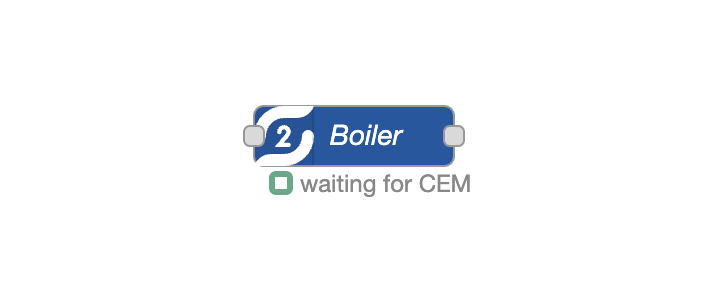
The recommended starting point is a single s2-resource node - one node instead of wiring five together:
Nodes
Below, each node's internal type (s2-resource, s2-rm, ...) is used for identification, as it appears in flow JSON and this documentation. In the Node-RED palette and on the canvas, they're shown without the redundant "s2-" prefix (e.g. s2-resource as just "resource") - all of them already sit under the "s2" palette category, and carry the S2 logo icon. resource is additionally shown with a blue background and white icon (instead of every other node's white background/colored icon), since it's the recommended starting point.
| Node | Description |
|---|---|
| s2-resource | Composite S2 Resource Manager - combines s2-rm, a built-in transport (WebSocket, D-Bus, or External), and a built-in control type (OMBC or None) behind one tabbed edit dialog. Recommended starting point: a minimal S2 flow needs just this one node instead of wiring the nodes below together. |
| s2-rm | S2 Resource Manager - generic S2 protocol state machine (handshake, control-type selection, instruction ack/routing) for a connected CEM, independent of any specific control type |
| s2-rm-config | Configuration for RM identity: resource ID, name, roles, control types, serial number, power measurement/forecast |
| s2-ombc | Operation Mode Based Control - declares the OMBC system description, resolves OMBC instructions, and confirms operation mode changes back to the CEM |
| s2-ombc-config | Configuration for s2-ombc: OMBC system description (operation modes, transitions, timers), with a friendly editor for the common case and a raw-JSON Advanced mode for everything else |
| s2-pebc | Power Envelope Based Control - accumulates power envelope schedules from PEBC instructions, dispatches the active bound as it becomes effective, caps outgoing PowerForecasts to the accumulated schedule, and (optionally) resolves which side of an asymmetric bound currently applies from your PowerMeasurement |
| s2-pebc-config | Configuration for s2-pebc: default power constraints (grid connection preset or custom wattage) |
| s2-cem-config | Configuration for CEM connection (WebSocket URL and credentials) |
| s2-websocket | WebSocket transport for S2 communication with a CEM |
| s2-dbus | Venus OS D-Bus transport for S2 - registers a com.victronenergy.<deviceType>.virtual_s2_<nodeId> D-Bus service for a CEM on the same GX device to call into directly, with the same message shapes s2-websocket uses. Also relays power measurement as real, readable D-Bus BusItem properties - see Sending power measurements over D-Bus |
| s2-dbus-config | Configuration for s2-dbus: D-Bus connection mode, device type (acload/heatpump), phases/wiring, power measurement type, and energy auto-calculation |
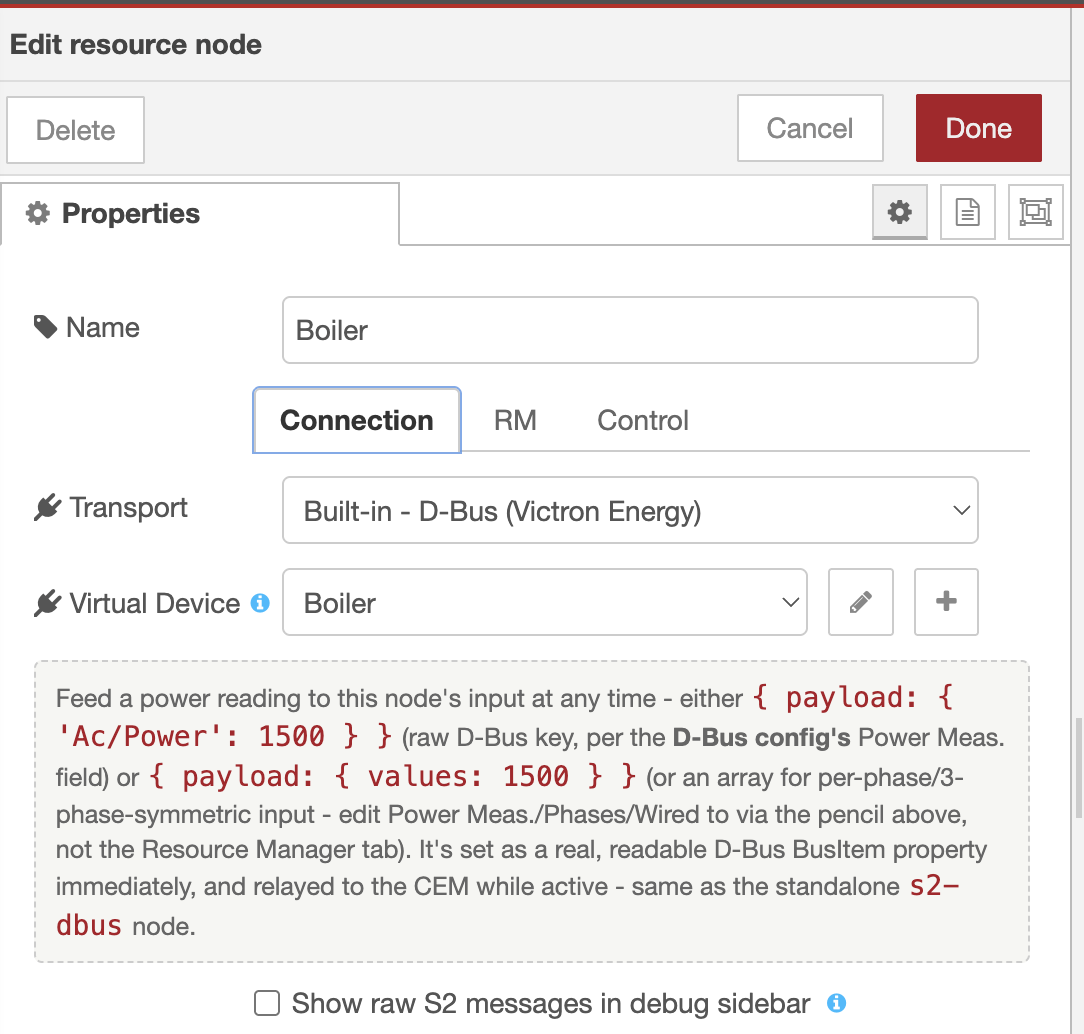
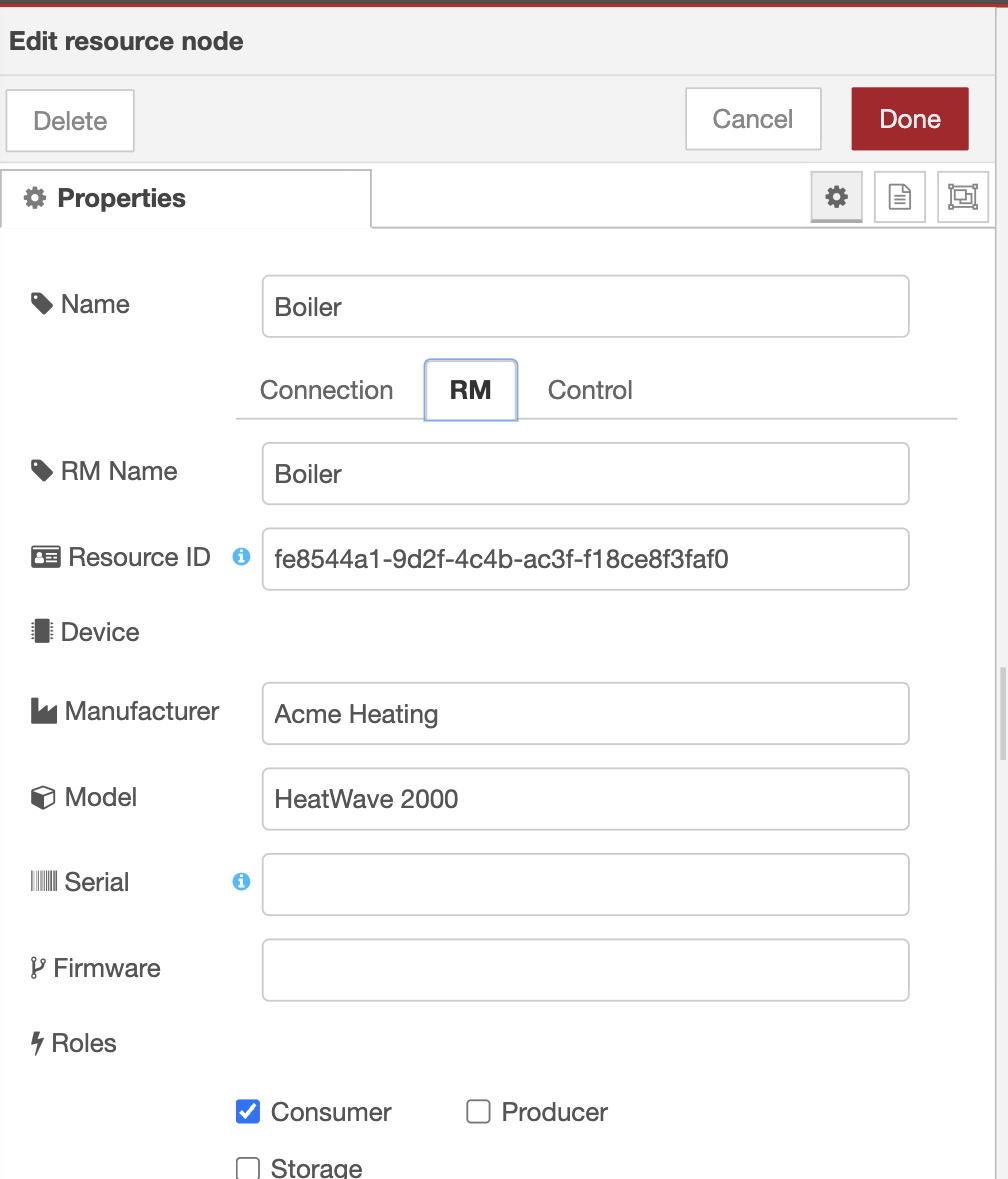
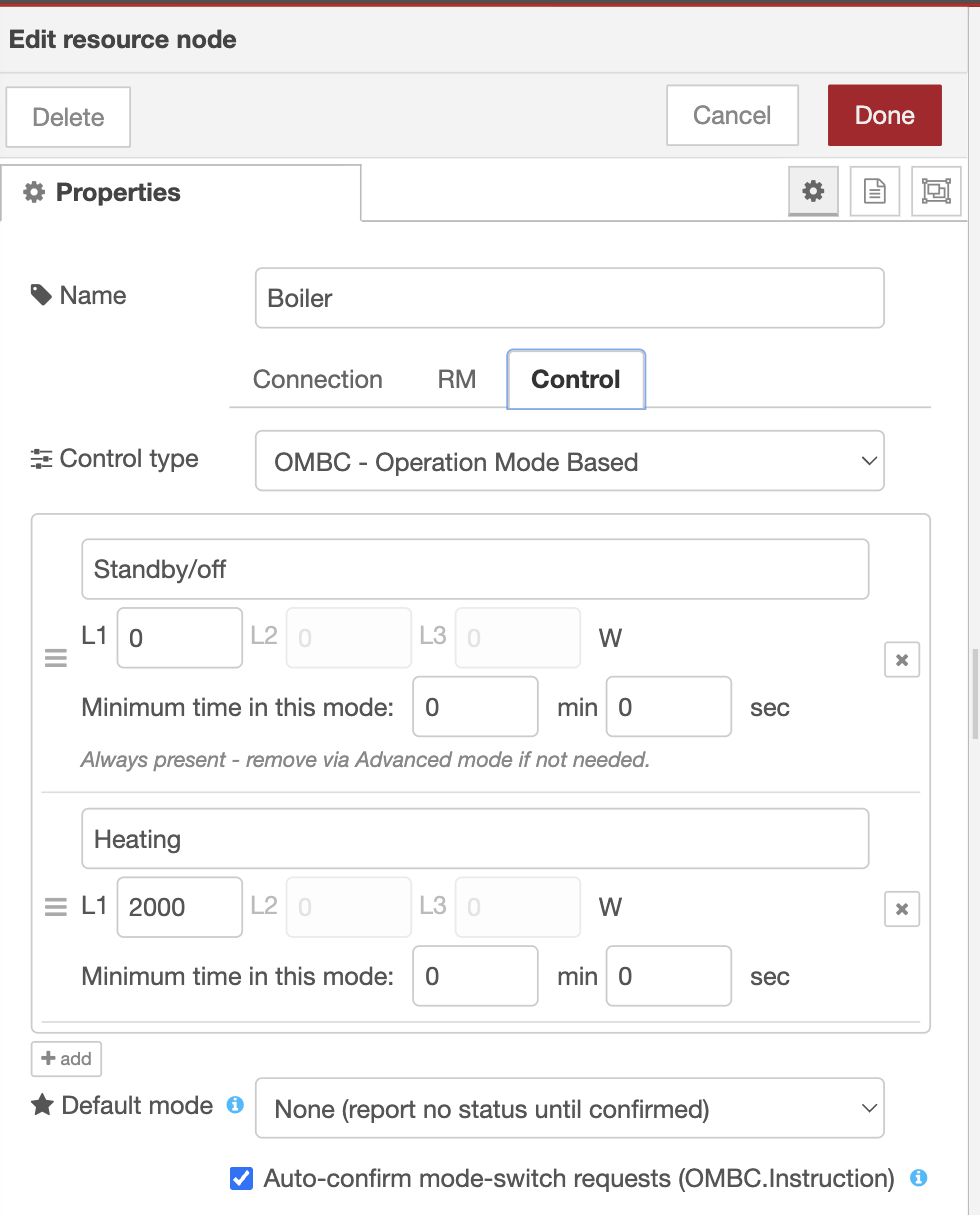
s2-resource's tabbed edit dialog - Connection (transport), RM (identity and capabilities), and Control (e.g. OMBC operation modes):
Features
- S2 protocol handshake and session management
- A composite s2-resource node for a minimal, single-node S2 flow, alongside the fully wired-together
s2-rm+ transport + control-type model - Operation Mode Based Control (OMBC), via the dedicated s2-ombc node
- Power Envelope Based Control (PEBC) with configurable power constraints, via the dedicated s2-pebc node
- WebSocket and Venus OS D-Bus transports (s2-websocket / s2-dbus), with no dependency on node-red-contrib-victron
- PowerMeasurement forwarding (3-phase symmetric or per-phase L1/L2/L3), including live D-Bus BusItem properties and optional energy (kWh) auto-calculation over the D-Bus transport
- PowerForecast support
- Multiple concurrent CEM sessions
- Configurable RM roles (Consumer, Producer, Storage)
- Context variable templates in serial number (e.g.
{{global.vrmId}}) - S2 messages are validated against the real S2 JSON schema on both the message path (
s2-rm) and at config-save time (s2-ombc-config's ands2-pebc-config's Advanced/JSON mode) - a malformed message, system description, or power constraints range is caught with a specific error instead of only failing downstream on the CEM side
Other S2 control types (FRBC, DDBC, PPBC) have no dedicated node yet - s2-rm forwards their instructions on its "from CEM" output, as raw S2 messages, for you to handle in your own flow.
Installation
Install via the Node-RED palette manager, or from the command line:
cd ~/.node-red
npm install node-red-contrib-s2
Quick start
For the simplest possible flow, drag in a single s2-resource node instead: pick Transport: WebSocket, D-Bus, or External and Control type: OMBC or None on its tabbed edit dialog, and it behaves like steps 1-5 below wired together (see the node's own help panel for its full tabbed configuration). The rest of this section covers the fully wired-together model, which s2-resource builds on and which you'd still use if you want OMBC/PEBC as separate nodes, or multiple resources sharing one CEM connection.
Add an s2-rm-config node and configure your Resource Manager identity (name, roles, control types).
Add an s2-cem-config node with the WebSocket URL and credentials of your CEM.
Wire an s2-websocket node to an s2-rm node:
- s2-websocket output 2 -> s2-rm input
- s2-rm output 1 -> s2-websocket input
s2-rm output 2 carries all S2 messages from the CEM (e.g. SelectControlType, ReceptionStatus, RevokeObject) and instructions (e.g.
OMBC.Instruction,PEBC.Instruction), as raw S2 messages withmsg.topicset to themessage_type.For OMBC or PEBC, add the matching control-type node (s2-ombc + s2-ombc-config, or s2-pebc + s2-pebc-config) and wire it up:
- s2-rm output 2 -> control-type node input (so it can observe
SelectControlType/RevokeObjectand resolve its own instructions) - control-type node's command output -> s2-rm input (routes
UpdateStatus/SystemDescription/PowerConstraints/InstructionStatuscommands back through s2-rm)
s2-ombcands2-pebccan be wired in parallel downstream of the sames2-rm- each ignores instructions meant for the other control type.If you're sending PowerForecasts and using
s2-pebc, route your Forecast command intos2-pebc's input too (instead of directly into s2-rm) - see Sending PowerForecasts.- s2-rm output 2 -> control-type node input (so it can observe
Examples
Import any of these from the Node-RED palette manager's "Import Examples" menu (or via Menu -> Import -> Examples -> node-red-contrib-s2):
| Example | Demonstrates |
|---|---|
s2-resource-quickstart |
The recommended starting point: the same boiler-OMBC scenario below, collapsed to a single s2-resource node (Transport: WebSocket, Control type: OMBC) plus the s2-cem-config it shares its CEM connection with. |
boiler-ombc-demo |
The fully wired-together model: s2-rm-config + s2-cem-config + s2-websocket + s2-rm + s2-ombc-config + s2-ombc, simulating a single-phase electric boiler with two operation modes (Standby/off, Normal 2500W) - no real hardware required. |
s2-dbus-quickstart |
The same boiler-OMBC scenario as boiler-ombc-demo, but over the s2-dbus transport (Venus OS D-Bus) instead of WebSocket - for a CEM running on the same GX device. |
opportunity-loads-sg-ready-ombc |
Models an SG-Ready-style heat pump/load as an OMBC resource, driven by a real Venus OS relay state instead of a fake trigger. |
opportunity-loads-mypv-ac-thor |
Drives a real My-PV AC-Thor 9s over its HTTP control API as an OMBC resource via s2-resource's built-in D-Bus transport, reporting back its own instructed power as the measurement (see Faking a measurement from an OMBC instruction). |
pebc-instruction-tester |
A standalone CEM-side tester (no S2 nodes involved) that POSTs PEBC.Instruction bodies at a resource manager's REST endpoint - useful for exercising s2-pebc without a real CEM. |
One resource ID per resource
A CEM tells resources apart by their resource ID alone, so every s2-resource (and every s2-rm-config) needs its own. The editor takes care of this: a node from the palette gets an ID straight away, and a copy-pasted s2-resource or a flow or example imported again with "Import copy" gets a new one, while a cut-and-paste keeps its ID so the CEM keeps its settings for that resource (for GX Opportunity Loads: its priority).
With Transport: WebSocket, s2-resource shows its Resource ID on the Connection tab, so you can register it with your CEM or replace it with the ID your CEM expects (2-64 letters, digits, -, _ or :; a warning shows when it isn't a UUID, which CEMs built on s2python require). For D-Bus it stays hidden: GX Opportunity Loads never needs it.
A copy-pasted s2-rm keeps using the original's s2-rm-config, so the editor marks the copy invalid until it gets its own s2-rm-config.
If two running nodes still end up with the same ID (e.g. a flow copy-pasted with a version before this check, or two s2-rm nodes sharing one s2-rm-config), the one that starts second refuses to start with a red duplicate resource ID status and an error naming the other node. Copy and paste the refused s2-resource (the copy gets a new ID) and delete the original, or give the s2-rm its own s2-rm-config, then deploy. A refused node is only retried when it is deployed again. The same applies to transports: only one s2-websocket, or s2-resource with a built-in transport, connects per resource ID. An s2-dbus doesn't know the resource ID, so one wired to a refused s2-rm still registers its D-Bus service, which never completes a handshake.
Inside a subflow, every instance needs its own resource ID. Set the Resource ID (shown inside subflows for every transport) to ${NAME} (or the older $(NAME)) and give each instance its own NAME subflow property; Node-RED substitutes it per instance. An instance without the variable refuses to start with a red resource ID variable not set status; one where it is blank refuses with resource ID missing, and one where it isn't a valid S2 ID with invalid resource ID.
Sending PowerMeasurements
To send power measurements to the CEM, set an inject node's payload to type JSON with the following value, and wire it into the s2-rm input (this is msg.payload, not the whole msg - don't wrap it in another { "payload": ... }):
{
  "command": "PowerMeasurement",
  "cemId": "cem",
  "values": [
    { "commodity_quantity": "ELECTRIC.POWER.3_PHASE_SYMMETRIC", "value": 1500 }
  ]
}
The s2-rm node emits a PowerMeasurementStart signal on output 1 when the CEM selects a control type, so you can use that to trigger periodic measurements.
Sending power measurements over D-Bus
s2-dbus and s2-resource (Transport: D-Bus) accept a power reading on their input at any time, independent of the message above - it's set as a real, readable D-Bus BusItem property immediately (visible to VRM/the GX device list/any other D-Bus consumer), and relayed to the CEM as a PowerMeasurement command while one has an active PowerMeasurementStart. Two input shapes are recognized, either of which may be used:
Raw D-Bus key, matching the configured
Power Meas.type exactly, e.g.{ payload: { 'Ac/Power': 1500 } }(3-phase symmetric) or{ payload: { 'Ac/L2/Power': 1500 } }(per phase).values, a friendlier shape whose meaning depends onPower Meas./Phases/Wired to:Power Meas. Phases valuesscalarvaluesarrayPer phase 1 the wired line's power (e.g. Wired to: L2->ELECTRIC.POWER.L2)rejected (only one real line to attribute elements to) Per phase 3 rejected (ambiguous which line a lone value belongs to) one element per phase, in L1/L2/L3order3-phase symmetric 3 sent as-is, and split evenly across Ac/L1-3/Powermust have exactly 3 elements - summed for the CEM/ Ac/Power, written directly (unsplit) toAc/L1-3/Power
Ac/Power is always kept as the live sum of whatever per-phase readings are currently known when Power Meas.: Per phase.
s2-dbus-config's "Auto-calculate energy" setting (on by default) integrates each tracked Power reading over time into a running Ac/[L<n>/]Energy/Forward total - the same approach node-red-contrib-victron's own virtual acload/heatpump devices use (forward/import energy only, no Reverse tracking).
Faking a measurement from an OMBC instruction
s2-ombc's (and s2-resource's built-in OMBC) ModeInstruction output already includes values in this same convenience shape, derived from the resolved mode's power range and factor - useful for a resource with no independent way to measure its own power (e.g. a My-PV AC-Thor-style load controlled purely by the instructed factor): wire ModeInstruction's values field straight into a PowerMeasurement input to report back exactly the power you were just told to produce, with no conversion in between.
Direction-aware limiting with s2-pebc
A PEBC power envelope can be asymmetric (different import and export bounds), but many devices only expose a single settable limit. If your s2-pebc node's input is also wired to your PowerMeasurement command (in addition to wherever else it already goes - no changes needed to what you send to s2-rm), it tracks your last measurement's sign and adds two fields to its active-element output:
direction:'import'or'export', from the sign of your last measurement for that commodity (defaults to'import'if none has been seen yet).limitW: the magnitude, in watts, of whichever bound applies -upperBoundfor import,|lowerBound|for export (ornullif that bound is unbounded).
Apply limitW to your single actuator instead of always using upperBound. If your measurement's direction flips mid-slot on an asymmetric bound, s2-pebc re-emits output 1 with the updated values (without resending InstructionStatus, since the instruction itself hasn't changed) - so a flow reading limitW stays correct as flow direction changes, not just at the start of each slot.
Sending PowerForecasts
Set an inject node's payload (msg.payload, type JSON) to:
{
  "command": "Forecast",
  "cemId": "cem",
  "forecast": {
    "startTime": "2026-04-14T10:00:00Z",
    "elements": [
      {
        "duration": 900000,
        "power_values": [
          { "commodity_quantity": "ELECTRIC.POWER.3_PHASE_SYMMETRIC", "value_expected": 1500 }
        ]
      }
    ]
  }
}
If a s2-pebc node is present, inject this into its input instead of directly into s2-rm - s2-pebc caps forecast.elements to its currently accumulated PEBC schedule (tightest overlapping bound per element) before forwarding the command to s2-rm on its output 3. With no accumulated schedule, or without s2-pebc in the path, the forecast is forwarded/sent unchanged.
Updating PEBC PowerConstraints
s2-pebc pushes a default constraints range on deploy (derived from its s2-pebc-config). To override it at runtime, set an inject node's payload (msg.payload, type JSON) to the following and wire it into the s2-rm input - unlike every other command, PowerConstraints applies globally and does not require a cemId:
{
  "command": "PowerConstraints",
  "constraints": {
    "commodityQuantity": "ELECTRIC.POWER.3_PHASE_SYMMETRIC",
    "minPower": -3000,
    "maxPower": 3000
  }
}
Constraints are stored at the node level and automatically (re-)sent whenever a CEM selects PEBC.
Updating available control types at runtime
NOT_CONTROLABLE in ResourceManagerDetails.available_control_types is opt-out: s2-rm-config's and s2-resource's control-types checklist has an Include "Not Controllable" in advertised control types checkbox, checked by default for newly created nodes, so a CEM can choose "don't control this resource" unless you explicitly uncheck it. Beyond that, the advertised list normally comes from deploy-time config (s2-rm-config's control-types list, or s2-resource's Control type selection).
To change what's currently controllable without redeploying - e.g. making an OMBC resource controllable only between 10:00 and 18:00 - set an inject node's payload (msg.payload, type JSON) to a SetAvailableControlTypes command and wire it into the s2-rm (or s2-resource) input. Like PowerConstraints, it applies globally and does not require a cemId. It takes either a full replacement list:
{
  "command": "SetAvailableControlTypes",
  "availableControlTypes": ["OPERATION_MODE_BASED_CONTROL"]
}
or an isControllable toggle for the common on/off case:
{
  "command": "SetAvailableControlTypes",
  "isControllable": false
}
The list form replaces the full advertised list verbatim - NOT_CONTROLABLE is only included if you put it in the list yourself. isControllable: false replaces the list with exactly ["NOT_CONTROLABLE"]; isControllable: true restores the list to whatever was configured at deploy time (the node's own control-types config, including whether its Include "Not Controllable" in advertised control types checkbox was checked), discarding any narrowing currently in effect. A payload must specify exactly one of availableControlTypes or isControllable - both, or neither, is rejected. Either form immediately re-sends ResourceManagerDetails to every currently connected CEM, with a fresh message_id. Wire your own trigger (an inject/cron node, or a time-window check) to send this command - there's no built-in scheduler. If a CEM's currently-selected control type drops out of the new list, its session is left alone (no forced deselect or disconnect) - only the resend happens.
isControllable: false is the recommended way to temporarily make a resource entirely uncontrollable (e.g. outside the 10:00-18:00 window above) without relying on list contents. It needs "Not Controllable" to be included in the configured control types, and is rejected otherwise. An empty "availableControlTypes": [] is rejected too: S2 requires at least one advertised control type.
Valid values: NOT_CONTROLABLE, OPERATION_MODE_BASED_CONTROL (OMBC), FILL_RATE_BASED_CONTROL (FRBC), DEMAND_DRIVEN_BASED_CONTROL (DDBC), POWER_PROFILE_BASED_CONTROL (PPBC), POWER_ENVELOPE_BASED_CONTROL (PEBC).
The node's status text always ends with a shortlist of its currently advertised control types (e.g. CEM connected (cem-1) - NC,OMBC, where NC is short for NOT_CONTROLABLE and always sorts first when present), abbreviated the same way - so a SetAvailableControlTypes command's effect is visible immediately, whether or not a CEM is connected.
Development
npm install
npm run build
npm test
License
MIT - Copyright (c) 2026 Victron Energy BV