@theotherwillembotha/node-red-temporal 0.4.6
Time value manipulation nodes for Node-RED. Built on @theotherwillembotha/node-red-plugincore.
node-red-temporal
Date and time manipulation nodes for Node-RED. Parse, convert, adjust, and compute durations between date/time values - built on the TC39 Temporal API via temporal-polyfill.
Requirements: Node.js ≥ 18, Node-RED ≥ 4.0.0
Features
- Read date/time values from
msg,flow,globalcontext, or the current timestamp - Parse all common formats - ISO 8601, Unix timestamps, RFC 2822, JavaScript Date objects, and custom Moment.js-style format strings
- Timezone-aware conversion using IANA timezone names (
Europe/Amsterdam) or UTC offsets (+02:00) - Optional time adjustment with a compact expression syntax (
+1y -2M +3d) - Compute durations between two timestamps in multiple output formats
- Interval measurement mode - automatically tracks the gap between consecutive messages
Installation
npm install @theotherwillembotha/node-red-temporal
Or search for node-red-temporal in the Node-RED palette manager.
Table of Contents
- Temporal Transform
- Temporal Duration
- Format reference
- Custom format strings
- Adjustment string syntax
- Timezone reference
- Error handling
- Examples
Temporal Transform
Transforms a date/time value from one representation to another in a single node.
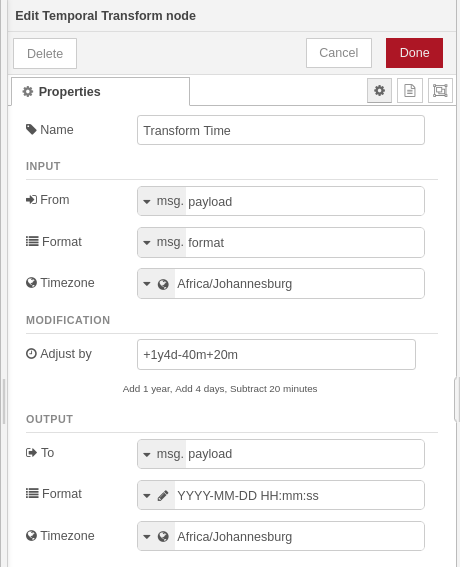
Input
| Field | Description |
|---|---|
| From | Where to read the date/time value. Supports msg, flow, and global properties, or timestamp (now) to capture the current time when the message arrives. |
| Format | How the input value is encoded. Choose a named preset or enter a custom format string. Can also be read dynamically from a msg, flow, or global property. |
| Timezone | The timezone the input value is expressed in. Required for formats that carry no timezone information (date, datetime, unix-s, unix-ms, rfc2822, and custom formats). Accepts IANA names or UTC offset strings. Can also be read from a property. |
When From is set to timestamp (now), Format is locked to milliseconds since epoch and Timezone has no effect.
Modification
| Field | Description |
|---|---|
| Adjust by | An optional expression that shifts the time value before output. Leave empty to pass through unchanged. A live preview below the field describes the adjustment in plain English - invalid expressions are highlighted in red. See Adjustment string syntax. |
Output
| Field | Description |
|---|---|
| To | Where to write the result. Supports msg, flow, and global properties. |
| Format | How to encode the output value. Choose a named preset or enter a custom format string. Can also be read dynamically from a property. |
| Timezone | The timezone to express the output value in. Accepts IANA names or UTC offset strings. |
Temporal Duration
Computes the duration between two date/time values.

From Time / To Time
Each endpoint has the same three fields:
| Field | Description |
|---|---|
| From / To | Where to read the date/time value. Supports msg, flow, and global properties, timestamp (now) to use the current time, or previous message (From only - see below). |
| Format | How the value is encoded. Choose a named preset or a custom format string. Hidden when timestamp (now) or previous message is selected. |
| Timezone | The IANA timezone or UTC offset the value is expressed in. Required for formats that carry no timezone information. |
The duration is always computed as To − From (positive when To is later than From).
Interval measurement - "previous message" mode
When From is set to previous message:
- The first message stores the To time as a baseline and is not forwarded.
- Every subsequent message computes the duration from the stored baseline to the current To time, writes the output, then stores the current To time as the new baseline.
- The stored baseline resets when the flow is redeployed.
This mode is useful for measuring the interval between recurring messages - sensor readings, heartbeats, pipeline throughput.
Offset
| Field | Description |
|---|---|
| Offset by | An optional expression that shifts the computed duration before output. Uses the same syntax as the Temporal Transform Adjust by field. Leave empty for no adjustment. |
Output
| Field | Description |
|---|---|
| To | Where to write the result. Supports msg, flow, and global properties. |
| Mode | How to express the duration. See output modes below. |
Output modes
| Mode | Output type | Description |
|---|---|---|
| Total in unit | number |
The entire duration as a single numeric value in the selected unit (milliseconds, seconds, minutes, hours, or days). Fractional values are returned where applicable. |
| Duration components | object |
A plain object with keys years, months, weeks, days, hours, minutes, seconds, milliseconds. Values are broken down from the selected Largest unit downward - fields for larger units are always zero. |
| ISO 8601 string | string |
The duration as an ISO 8601 duration string, e.g. P1Y2M3DT4H5M6S. |
| Human readable | string |
A locale-formatted string using Intl.DurationFormat with English locale and the selected style. |
Human readable styles
| Style | Example |
|---|---|
| Long | 2 hours, 30 minutes, 5 seconds |
| Short | 2 hr., 30 min., 5 sec. |
| Narrow | 2h 30m 5s |
Format reference
The following named presets are available in both nodes:
| Preset | Description | Example |
|---|---|---|
iso |
ISO 8601 with timezone offset | 2024-05-16T14:30:00+02:00 |
iso-utc |
ISO 8601 UTC (Zulu) | 2024-05-16T12:30:00.000Z |
date |
Date only | 2024-05-16 |
datetime |
Date and local time (no timezone) | 2024-05-16 14:30:00 |
unix-s |
Seconds since epoch | 1715860200 |
unix-ms |
Milliseconds since epoch | 1715860200000 |
js-date |
JavaScript Date object | (Node.js Date instance) |
rfc2822 |
RFC 2822 email date format | Thu, 16 May 2024 14:30:00 +0200 |
Custom format strings
Select custom to enter a format string using Moment.js-style tokens. Tokens are case-sensitive and matched longest-first.
| Token | Description | Example | Token | Description | Example |
|---|---|---|---|---|---|
YYYY |
Year (4-digit) | 2024 |
hh |
Hour 12 h, padded | 02 |
YY |
Year (2-digit) | 24 |
h |
Hour 12 h | 2 |
MM |
Month, padded | 05 |
mm |
Minute, padded | 30 |
M |
Month | 5 |
m |
Minute | 30 |
DD |
Day, padded | 06 |
ss |
Second, padded | 05 |
D |
Day | 6 |
s |
Second | 5 |
HH |
Hour 24 h, padded | 14 |
SSS |
Milliseconds | 047 |
H |
Hour 24 h | 14 |
A / a |
AM/PM or am/pm | PM |
Any character that does not match a token is treated as a literal separator (e.g. -, /, , :).
Examples
| Format string | Output |
|---|---|
YYYY-MM-DD |
2024-05-16 |
DD/MM/YYYY |
16/05/2024 |
DD/MM/YYYY HH:mm:ss |
16/05/2024 14:30:05 |
YYYY-MM-DD HH:mm:ss.SSS |
2024-05-16 14:30:05.047 |
hh:mm:ss A |
02:30:05 PM |
YYYY-MM-DDTHH:mm:ss |
2024-05-16T14:30:05 |
Named month abbreviations (e.g.
Jan,Feb) are not supported - the format system works with numeric values only.
Adjustment string syntax
The Adjust by field (Temporal Transform) and Offset by field (Temporal Duration) accept the same compact expression syntax.
Units
| Token | Unit | Token | Unit |
|---|---|---|---|
y |
Years (calendar) | H |
Hours |
M |
Months (calendar) | m |
Minutes |
w |
Weeks (= 7 days) | s |
Seconds |
d |
Days | S |
Milliseconds |
Tokens are case-sensitive:
Mis months,mis minutes;His hours,Sis milliseconds.
Syntax rules
- Prefix each group with
+(add) or-(subtract). - A sign applies to all units that follow it until the next sign:
-1H30msubtracts both 1 hour and 30 minutes. - Multiple groups can be combined freely:
+1y -2M +3d - Whitespace is ignored:
+1y -2Mand+1y-2Mare equivalent. - The same unit may appear multiple times - values are accumulated:
+1H +1Hequals+2H. - An empty string means no adjustment - the value passes through unchanged.
Examples
| String | Effect |
|---|---|
+1y |
Add 1 year |
-30m |
Subtract 30 minutes |
+1y4d |
Add 1 year and 4 days |
+1y4d-40m+20m |
Add 1 year, add 4 days, subtract net 20 minutes |
+1M -1d |
Add 1 month, subtract 1 day |
-1H30m |
Subtract 1 hour and 30 minutes |
+500S |
Add 500 milliseconds |
+1w3d |
Add 10 days (1 week + 3 days) |
Calendar unit behaviour
Calendar units (y and M) operate on the calendar date, not a fixed duration. The result is clamped to the last valid day of the month where necessary:
- Adding 1 month to
2024-01-31→2024-02-29(leap year end of February) - Adding 1 year to
2024-02-29→2025-02-28(non-leap year)
Timezone reference
Timezone fields accept:
- IANA timezone names - e.g.
Europe/Amsterdam,America/New_York,Asia/Tokyo,UTC - UTC offset strings - e.g.
+02:00,-05:30,+00:00
An autocomplete dropdown is available in the editor for IANA names. The full list is sourced from the server's Intl.supportedValuesOf('timeZone').
Error handling
If a date/time value cannot be parsed, or if an adjustment/offset expression is invalid:
- The message is dropped (not forwarded to the output).
- A warning is logged on the node, visible in the Node-RED debug panel.
Downstream nodes only receive messages that were processed successfully.
Examples
Convert a Unix timestamp to a human-readable local time
| Field | Value |
|---|---|
| From | msg.payload - milliseconds since epoch |
| Timezone | UTC |
| To | msg.payload |
| Output Format | YYYY-MM-DD HH:mm:ss (custom) |
| Output Timezone | Europe/Amsterdam |
1715860200000 → 2024-05-16 14:30:00
Add a 5-day offset and output ISO UTC
| Field | Value |
|---|---|
| From | msg.payload - ISO 8601 with offset |
| Adjust by | +5d |
| Output Format | iso-utc |
2024-05-16T14:30:00+02:00 → 2024-05-21T12:30:00.000Z
Capture the current time in a local timezone
| Field | Value |
|---|---|
| From | timestamp (now) |
| To | msg.timestamp |
| Output Format | YYYY-MM-DD HH:mm:ss (custom) |
| Output Timezone | Africa/Johannesburg |
Writes the current local time in Johannesburg to msg.timestamp.
Compute the total seconds between two timestamps
| Field | Value |
|---|---|
| From | msg.start - milliseconds since epoch, timezone UTC |
| To | msg.end - milliseconds since epoch, timezone UTC |
| Mode | Total in unit - Seconds |
| Output To | msg.payload |
Measure the interval between messages
| Field | Value |
|---|---|
| From | previous message |
| To | msg.payload - milliseconds since epoch, timezone UTC |
| Mode | Total in unit - Milliseconds |
| Output To | msg.interval |
The first message is stored as the baseline and dropped. Every subsequent message writes the elapsed milliseconds since the previous one to msg.interval.
License
ISC
