@rosepetal/node-red-contrib-async-function 1.1.0
A Node-RED function node that runs code in worker threads to keep your flows responsive
node-red-contrib-async-function
Run heavy computations in Node-RED without slowing down your flows. This node works like the function node you already know, but keeps things responsive when the work gets heavy.
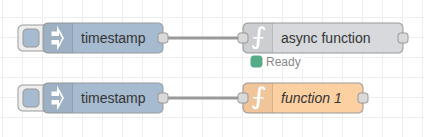
What You Get
- Write JavaScript code that feels familiar—same as the function node.
- Run CPU-intensive tasks without blocking other flows.
- See real-time stats showing active workers and queue depth.
- Configure worker pools to match your workload.
- Handle bursts of messages smoothly with automatic queuing.
- Add external npm modules with auto-installation support.
Before You Start
- Node.js 18 or newer (worker threads need it).
- Node-RED 2.0 or newer.
How It Works
Drop a worker function node into your flow. Write your code just like you would in a regular function node. The difference? Your code runs in a separate worker thread by default (or a child process if configured), so heavy operations won't freeze Node-RED.
When to Use This
Great For:
- Calculating prime numbers, running crypto operations, or processing large datasets.
- Tasks that take more than 10 milliseconds to finish.
- Keeping your dashboard and other flows responsive during heavy work.
Skip It For:
- Simple math or quick transformations (the regular function node is faster).
- Flows that require live context reads/writes during execution (context is snapshot-based).
Node Options
Code & Behavior
- Name – Optional label for your canvas.
- Function – Your JavaScript code. Works with
async/await,return, andrequire(). - Outputs – How many output wires (0-10). Return an array for multiple outputs.
- Timeout – Maximum seconds to wait before killing the worker. Default: 30 seconds.
- Runtime – Worker Threads (default, fastest) or Child Process (for native modules like
gl).
Worker Pool
- Workers – Fixed number of workers (1-16). Each node maintains exactly this many workers. Default: 3.
- Queue Size – Messages to queue when all workers are occupied. Default: 100.
Modules
Add external npm modules that will be available in your code. Similar to the standard Node-RED function node's module feature.
- Module – The npm package name (e.g.,
lodash,moment,@scope/package). - Import as – Variable name to access the module in your code.
Modules are auto-installed to ~/.node-red on first deploy if not already available. Use them directly in your code without require():
// With modules: lodash → _, moment → moment
const doubled = _.map(msg.payload, x => x * 2);
msg.timestamp = moment().format('YYYY-MM-DD');
return msg;
Buffer Handling
- Buffers – Worker Threads use zero-copy transfer when possible. Child Process mode and non-transferable buffers fall back to shared memory (
/dev/shmon Linux, otherwiseos.tmpdir()), with base64 fallback if needed.
Typical Flow
- Add a worker function node to your workspace.
- Connect an Inject node (input) and a Debug node (output).
- Write a simple script:
msg.payload = msg.payload * 2; return msg; - Deploy and trigger. Watch the status update in real time.
What You Can Use in Your Code
Available:
msg– The message object (must be serializable)return– Return a single message or array of messagesasync/await– For asynchronous operationsrequire()– Load Node.js built-in or installed modules- Configured modules – Available directly as variables (no require needed)
console– Logging functionssetTimeout,setInterval– Timers
Notes:
context,flow,globalare snapshot-based: reads are from the snapshot, writes are applied after the function completes- Snapshot includes only literal keys found in
flow.get("key")/global.get("key")/context.get("key") - Context store selection is not supported (default store only)
node.warn/error/logare collected and forwarded to the main thread- Non-serializable objects (functions, symbols, etc.)
Code Examples
Simple Transformation
msg.payload = msg.payload * 2;
return msg;
Using External Modules
Option 1: Configure in Setup tab (recommended)
Add the module in the Modules section of the Setup tab, then use it directly:
// Module configured: lodash → _
msg.payload = _.sortBy(msg.payload, 'name');
return msg;
Option 2: Traditional require()
const crypto = require('crypto');

msg.hash = crypto.createHash('sha256')
    .update(msg.payload)
    .digest('hex');

return msg;
CPU-Intensive Task (Won't Block!)
function isPrime(n) {
    if (n <= 1) return false;
    for (let i = 2; i * i <= n; i++) {
        if (n % i === 0) return false;
    }
    return true;
}

const limit = msg.payload;
const primes = [];

for (let i = 2; i <= limit; i++) {
    if (isPrime(i)) {
        primes.push(i);
    }
}

msg.payload = primes;
return msg;
Multiple Outputs
if (msg.payload > 100) {
    return [msg, null];  // Send to first output
} else {
    return [null, msg];  // Send to second output
}
Status Display
The node shows you what's happening in real time:
- Active: 2/4 – 2 workers processing out of 4 total
- Queue: 5 – 5 messages waiting
- Green dot – Normal operation
- Yellow dot – Queue filling up (>50 messages)
- Red dot – Queue almost full (>90%) or error
- Ring – All workers busy with a backlog
Performance Notes
- Worker threads add about 5-10ms overhead per message (child process mode is higher).
- Best for operations taking more than 10ms to run.
- Each node maintains a fixed pool of workers—no startup delay or dynamic scaling overhead.
- Workers are dedicated per-node, ensuring predictable performance.
- Binary Fast Path: Worker threads use zero-copy transfer when possible; shared memory is the fallback.
- Event loop never blocks, even when processing multi-MB binary data (images, files, etc.).
Error Handling
Errors in your code get caught and sent to a Catch node:
if (!msg.payload) {
    throw new Error('Payload is required');
}
Installation
cd ~/.node-red
npm install @rosepetal/node-red-contrib-async-function
Restart Node-RED and find the node in the function category.
Migration
From minWorkers/maxWorkers
If you're upgrading from a version that used minWorkers and maxWorkers:
- Your existing flows will automatically migrate to use the new
numWorkersparameter - The migration uses your previous
maxWorkersvalue as the fixed worker count - Check the Node-RED log for migration messages
- Edit your nodes to see the new simplified "Workers" configuration field
- Note: The new version uses a fixed worker pool instead of dynamic scaling for more predictable performance
Contributing
Found a bug or have an idea? Open an issue or pull request on GitHub.
License
Apache-2.0 © 2025 Rosepetal
Built by Rosepetal – Making Node-RED flows faster and friendlier.